

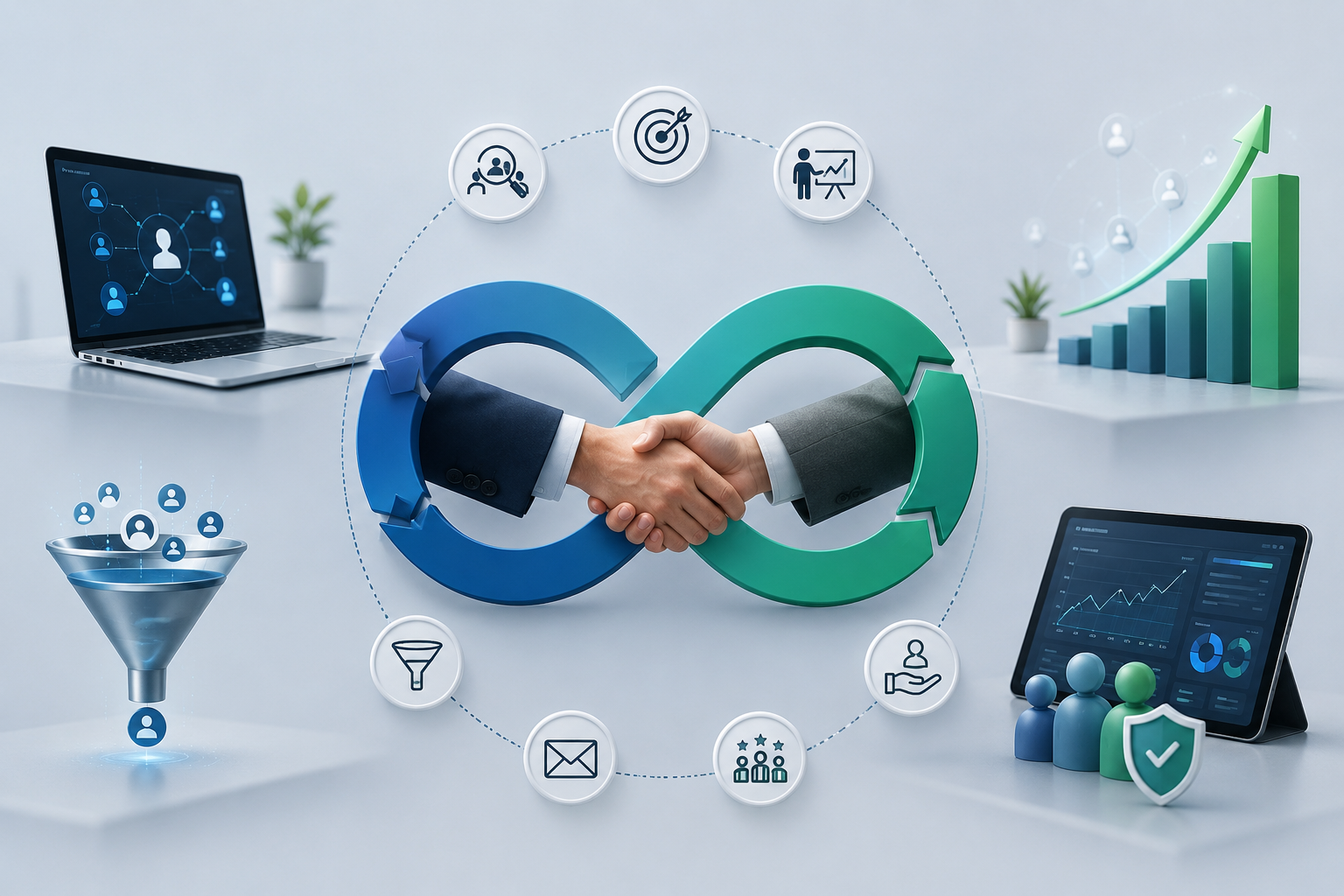
How Lifecycle Marketing Creates Long-Term Revenue Opportunities
Most B2B companies pour budget into lead generation and then wonder why revenue growth slows down. The problem is not the leads. The problem is what happens after. Research states that a 5% increase in customer retention can grow profits by up to 95%. Yet most marketing strategies stop at acquisition.
A B2B digital marketing agency that operates with a lifecycle-first mindset changes that dynamic entirely. It unifies all customer relationship interactions into a single revenue engine. Lifecycle marketing, from pre-sale relationship nurturing through to post-sale expansion and retention, enables businesses to transform customer relationships into sustained revenue.
This is not about doing more marketing. This is about doing smarter marketing that compounds over time. The shift from acquisition-only to full lifecycle thinking is where the biggest commercial gains are hiding today.
Why Acquisition-Only Marketing Create a Revenue Ceiling
Acquiring new prospects while managing existing customer relationships is costly. And this cost continues to grow annually. A good B2B digital marketing agency prioritizes customer relationships long after the point of purchase.
After all, acquiring a new customer costs 5 to 25 times more than retaining an existing one.
However, many marketing teams only think about filling the pipeline, which could eventually lead to more leads but doesn't bring about optimal value. The real value comes from managing your customers post the first conversion stage, where retention, up-selling, and customer relationship contribute much more revenue in the long run.
The Hidden Cost of Stopping at the Sale
- Marketing investment concentrates at the top of the funnel.
- Onboarding and expansion receive minimal strategic attention.
- Customer churn quietly erases the gains from demand generation.
Research shows that 80% of future revenue comes from just 20% of existing customers. That makes post-sale engagement one of the highest-return activities a B2B digital marketing agency can build for its clients. The ceiling breaks the moment marketing extends its mandate beyond the first transaction.
Acquisition vs Lifecycle Marketing: A Strategic Comparison
Most marketing teams are optimised for one goal: generate leads. Lifecycle marketing changes the governing objective to maximising revenue per relationship.
| Dimension | Acquisition Marketing | Lifecycle Marketing |
|---|---|---|
| Primary Goal | Generate new leads | Maximise revenue per customer relationship |
| Time Horizon | Campaign-based | Continuous |
| Success Metric | Marketing Qualified Leads (MQLs) and Cost Per Lead (CPL) | Customer Lifetime Value (LTV), retention rate, and expansion revenue |
| Customer View | Prospect | Evolving stakeholder |
| Agency Role | Demand generation partner | Revenue continuity partner |
Why the Shift in Mindset Matters
An acquisition-focused agency measures success at the handoff to sales. A lifecycle-focused agency measures success at renewal, expansion, and advocacy. These are fundamentally different performance cultures. The second one builds enterprise value. The first one builds pipeline noise.
The Three Phases Where a B2B Digital Marketing Agency Drives Continuity
A strong lifecycle programme runs across three distinct phases. Each one feeds the next.
Phase 1: Pre-Sales
- Demand creation through targeted content and paid channels.
- Nurture architecture that moves prospects through complex buying committees.
- Sales enablement content that shortens deal cycles.
Phase 2: Onboarding and Activation
- Messaging that bridges the purchase decision to first value realisation.
- Structured communication flows that reduce time-to-value.
- Early success signals that increase product adoption and confidence.
Phase 3: Post-Sales Growth
- Expansion triggers based on product usage and account health signals.
- Advocacy programmes that turn satisfied customers into active referral sources.
- Account-level re-engagement campaigns for renewal and upsell windows.
The Infrastructure That Makes Lifecycle Marketing Work
Effective lifecycle marketing is not a content calendar. It is a connected system.
- Unified data architecture that links CRM data with behavioural signals and campaign performance.
- Stage-specific content strategy built around where the customer is in their journey, not just who they are as a buyer persona.
- Marketing automation that responds to lifecycle signals rather than fixed scheduling.
How a B2B Digital Marketing Agency Operationalises This
Enterprise accounts are complex. Buying committees are large. Decision cycles are long. A B2B digital marketing agency operationalises lifecycle infrastructure by mapping signals to actions at the account level. When a customer reaches a usage threshold that signals expansion readiness, the system responds. When an account goes quiet ahead of a renewal window, the re-engagement sequence fires. This is not batch-and-blast marketing. This is revenue architecture.
Denave's Approach to Lifecycle-Led B2B Marketing
Denave designs programmes with revenue continuity as the governing objective from day one.
- Pre-sales engagement strategy integrates directly with post-sales growth motions.
- Sector-specific lifecycle frameworks align with enterprise buying cycles and renewal windows.
- Every programme connects marketing activity to measurable business outcomes.
Clients report improved retention rates, higher expansion revenue from existing accounts, and stronger pipeline quality because warm relationships convert faster than cold outreach. At Denave, the agency role is seen as a revenue partnership, not a campaign vendor relationship.
Conclusion
The most commercially mature B2B organisations have already made this shift. They no longer ask how to get more leads. They ask how to maximise the value of every relationship they already have. A B2B digital marketing agency that builds lifecycle continuity from pre-sales through to post-sales expansion becomes far more than a marketing vendor. It becomes the connective tissue between growth today and growth compounding over time. That is the standard worth building to.
FAQs
Q1:How does a B2B digital marketing agency plan lifecycle marketing for enterprise customers?
Ans:First, they map out the complete customer journey starting from the initial awareness through renewal and expansion. After that, they create phase-specific playbooks outlining triggers, content assets, and success metrics.
Q3:What features should be offered by a B2B digital marketing agency to handle post-sale engagement?
Ans:The agency must be skilled in CRM integration, marketing automation, and account-based marketing, and able to create content with speaking customers (those who already purchased) and not prospects (still comparing).
Q3:How a B2B digital marketing agency can help with account expansion within existing accounts?
Ans:The agency watches for account usage signals, engagement, and account health scores to know when to prompt the expansion conversation, then builds the campaign sequences and content to support it.
Q4:What data frameworks does a B2B digital marketing agency use to measure lifecycle performance?
Ans:Customer lifetime value, retention rate, expansion revenue, new customer time-to-value, and net revenue retention. They often replace or supplement traditional acquisition metrics, such as MQLs and CPL.
Q5:How does a B2B digital marketing agency work with the in-house teams to ensure lasting customer value?
Ans:The agency works with sales, customer success, and product teams to synchronize messaging, data, and outreach at each customer life cycle phase. Revenue longevity can only exist if all revenue-facing teams have common customer knowledge.
Read Responses
No Comments
Leave a Reply
Your email address will not be published.