

In Singapore’s committee-led B2B environment, momentum is won or lost at the moment of live engagement — when signals, stakeholders, and timing converge. This is where predictive intelligence stops being analytical and becomes commercial leverage.
Intent-driven Telesales sits at that inflection point, translating intent surges, persona dynamics, technographic readiness, and stakeholder alignment into decisive conversations that move committees forward and advance deals with execution certainty.

Native language capabilities

Customers touched daily

Higher sales appointments

Call Quality Assurance Score

Global Key Accounts Director & Business Head - APAC
“In today’s evolving B2B sales dynamics, Telesales can help organizations acquire new customers faster, re-engage with dormant accounts, open doors for the sales team and help filter the digital outreach data and pass on only warmer leads to the sales team. Telesales can also help acquire new partners and engage and grow contributions with existing partners.”
Deals in APAC and Singapore’s precision-led B2B market rarely fail due to lack of activity — they stall due to misalignment. Outreach happens before authority is clear. Conversations begin before readiness is validated. Multiple stakeholders engage, but consensus never quite forms. Traditional telesales treats every signal as equal and every call as progress, creating motion without direction.
<br>However, without real-time correlation between predictive intent signals, persona authority, technographic readiness, and committee dynamics, conversations lose urgency, follow-ups multiply, and momentum dissipates across buying groups — even when interest is genuine. This is where Intent-driven Telesales bridges the gap.

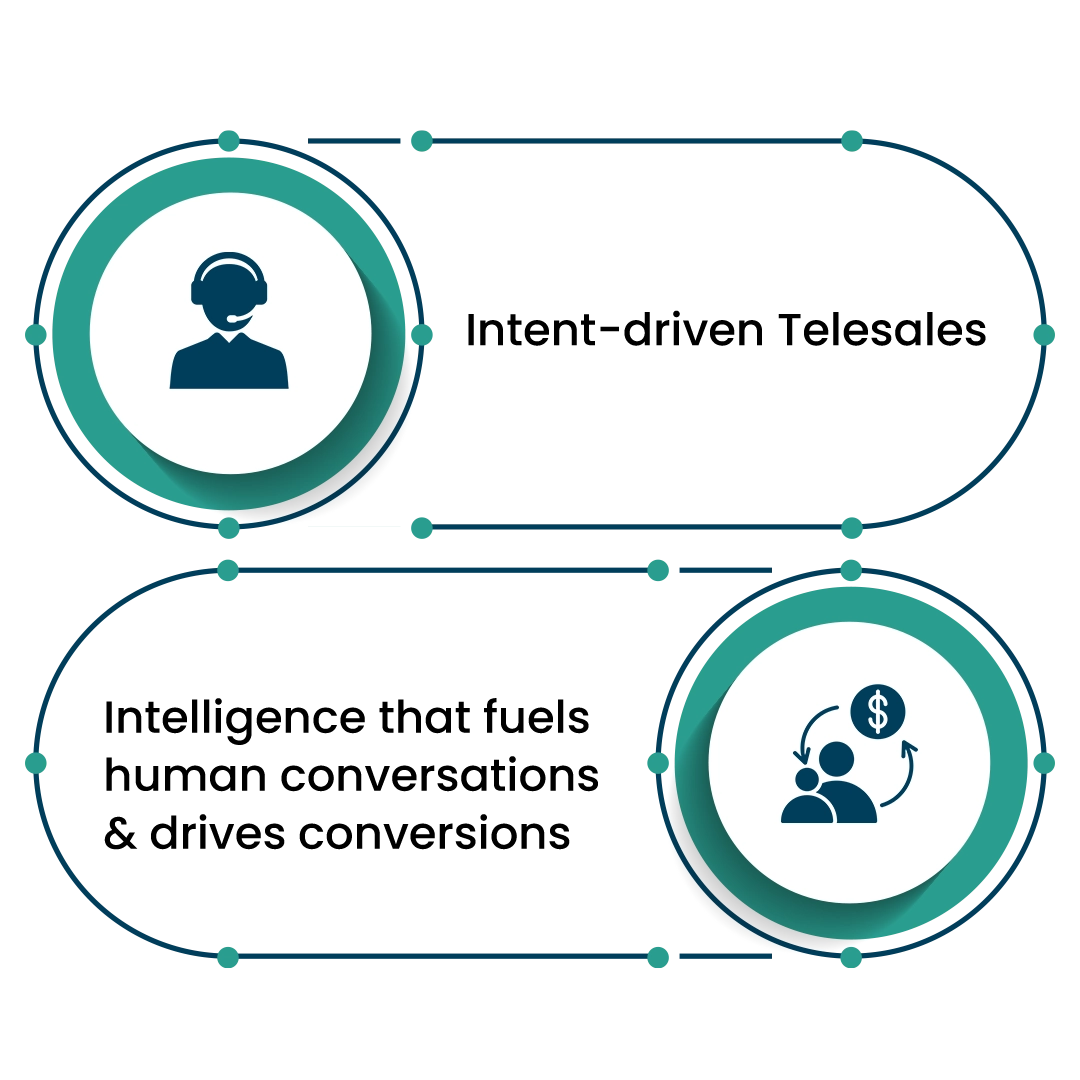
When conversations are triggered without intelligence, progress becomes accidental. Intent-driven Telesales changes this dynamic by redefining when and why engagement begins. Conversations are initiated by experienced, multilingual SDRs with a clear justification for action — grounded in readiness, relevance, and influence context — rather than volume-driven cadences. This shift replaces reactive follow-ups with purposeful progression, allowing momentum to carry forward across stakeholders and committees instead of resetting at every interaction. The outcome is not more activity, but steadier deal movement before execution complexity sets in — across regions, languages, and buying cultures.


Power up your customer engagement and deliver frictionless customer experiences through our 24*7 BPO outsourcing services. Whether it is enquiry handling, call answering, customer support, or lead generation, our multilingual customer service teams do it all for you.

Resolve your customer queries and troubleshoot their issues or grievances in real-time with our proactive tele agents. Our technical support agents enhance your customer experience and CSAT scores with the seamless resolution to any technical problem.

Our chat support teams enable your customers to communicate and interact with your business at any time and from any device to resolve their issues. Our native teams deliver seamless customer experience to drive higher customer satisfaction, maximize cost efficiencies, and provide business continuity.

We deliver integrated email support services to help customers communicating their concerns via emails and build trust and confidence in your brand. Our digital-native teams are trained in effective email communication to deliver enhanced customer experience.

With our large telesales teams operating across APAC, we help businesses identify new opportunities for expansion and growth by executing a comprehensive market research campaign. Conduct competitor research and identify trends to boost business growth.

Leverage nearshore and offshore telemarketing services to maximize BANT-qualified leads and sales appointments, allowing your sales teams to close more deals. Our agents apply multiple strategies to identify, attract, and engage prospects across multiple channels.

To keep pace with changing business dynamics, organizations should mine enterprise data to gain competitive advantage and make confident business decisions.

Transform visitors into leads with our audience-led and customer-focused approach.

Implementing an end-to-end sales process automation makes it easy to calculate the overall sales impact.

Turn cold calls into warm calls by leveraging our complete and contactable B2B data across industries.
Singapore's B2B market is precision-led — buyers are digitally mature, time-poor, and evaluate multiple vendors simultaneously. Traditional telesales that relies on volume and cadence loses deals not from lack of activity, but from misaligned timing and irrelevant conversations. Denave's Intent-driven Telesales activates only when IntelliBank detects ICP fit, intent surges, technographic readiness, and stakeholder alignment converging — so every SDR conversation in Singapore begins with a clear commercial justification, not a cold script.
Most deal stalls in Singapore's committee-led GTM environment happen because outreach begins before authority is confirmed, conversations start before readiness is validated, and follow-ups multiply without advancing consensus across buying groups. Intent-driven Telesales addresses this directly — SDRs engage when predictive signals confirm readiness, conversations are structured around committee dynamics, and each interaction is designed to move collective stakeholder momentum rather than just log a touchpoint.
IntelliBank is the predictive intelligence core behind Denave's telesales engine. It studies historical buying behavior, intent patterns, technographic signals, and engagement trends to score and prioritize accounts by conversion probability — then embeds that intelligence directly into the SDR workflow. For Singapore campaigns, this means callers begin every conversation pre-loaded with ICP fit context, persona roles, budget window signals, and objection intelligence — reducing account research time by up to 80% and driving significantly faster first-connect success.
Singapore's enterprise procurement rarely sits with a single buyer. IT, finance, procurement, legal, and C-suite stakeholders often all have a role, and momentum stalls when only one layer is engaged. Denave maps buying committees in full — champions, influencers, blockers, and decision-makers — and structures SDR outreach to build consensus across all of them simultaneously. Motivation-aware conversations advance influence at each stakeholder level, preventing the deal from stalling when it moves up the approval chain.
Denave's Intent-driven Telesales delivers 4X higher sales appointments compared to traditional telesales, a 98% call quality assurance score, and measurably faster deal velocity driven by purposeful, intelligence-led engagement. SDRs engage 100K+ customers daily across APAC with 30+ native language capabilities — ensuring Singapore campaigns benefit from both local precision and regional scale when needed.
Denave maintains a 98% call quality assurance score through structured conversation frameworks, real-time persona context from IntelliBank, objection guidance embedded in the SDR workflow, and continuous performance calibration based on campaign data. SDRs are not measured on call volume but on pipeline movement and influence activation — ensuring quality and outcome alignment are built into every conversation, not just monitored after the fact.
Every outreach motion is tied directly to pipeline movement and influence activation — not disconnected activity metrics. For technology vendors and channel partners running MDF or PDF-funded telesales programs in Singapore, this outcome-aligned measurement model makes it straightforward to demonstrate measurable pipeline return on co-funded investment. Reporting is built around deal progression and SQL quality, not dials made or hours billed.
Denave offers end-to-end BPO outsourcing across inbound and outbound call center services, technical support, chat support, email support, market surveys and research, and BANT-qualified lead generation. Multilingual customer service teams operate 24/7, enabling Singapore businesses to outsource customer engagement functions without sacrificing quality or local market relevance. All BPO services are underpinned by the same IntelliBank intelligence layer, ensuring even support interactions are informed by account context.
Singapore's business community operates across English, Mandarin, Malay, and Tamil — and enterprise deals often involve stakeholders with different language preferences within the same account. Denave deploys SDRs with 30+ native language capabilities, ensuring conversations are conducted in the stakeholder's preferred language with culturally appropriate communication styles. This linguistic and cultural precision reduces friction in early-stage conversations and accelerates trust-building — a critical advantage in Singapore's relationship-driven enterprise selling environment.
Telesales sits at the conversion point of a fully connected GTM framework. IntelliBank feeds account and persona intelligence from Sales Intelligence and Intelligent Data Services into SDR workflows before each call. Demand Generation warms accounts digitally before live engagement begins. After conversations, pipeline signals flow back into nurture sequences, partner enablement programs, and digital retargeting — ensuring every conversation compounds into measurable deal progression rather than operating as a standalone activity.
Many multinationals and regional enterprises run APAC GTM programs from Singapore — and Denave's telesales infrastructure is built for exactly this operating model. With 30+ language capabilities, delivery operations across Singapore, Malaysia, South Korea, and India, and IntelliBank's APAC-wide account intelligence layer, Denave can run telesales programs across Southeast Asia and North Asia from a single Singapore-anchored framework. This eliminates the need to contract separate telesales vendors for each country while maintaining local language and cultural precision in every market.
Denave's telesales programs deliver the strongest results in industries with complex, multi-stakeholder buying cycles — financial services and fintech, cloud and SaaS, cybersecurity, IT/ITeS, telecom, professional services, and ERP. These are the sectors that define Singapore's B2B landscape and where a well-timed, intelligence-led conversation from a knowledgeable SDR consistently outperforms digital-only outreach. Denave's vertical expertise in persona mapping, use-case alignment, and objection handling is calibrated to how these industries actually make purchase decisions in Singapore.
Because IntelliBank pre-loads ICP fit, persona context, intent signals, and account intelligence before the first call is made, Denave's ramp-up is significantly faster than traditional telesales setups where SDRs spend weeks building prospect knowledge. Research time is cut by up to 80%, meaning Singapore campaigns can move from brief to live outreach quickly — without sacrificing the conversation quality that makes first engagements credible, relevant, and conversion-ready from the very first interaction.